
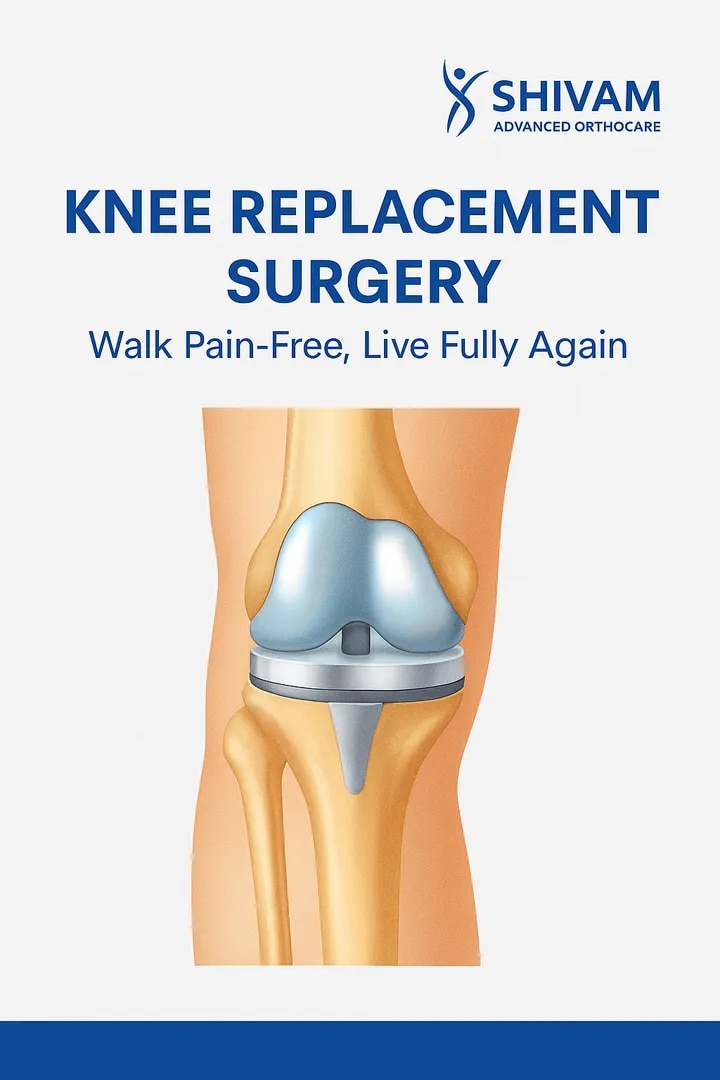
Knee Replacement Surgery
Description
Knee Replacement Surgery – Walk Pain-Free Again
When knee pain starts deciding how far you walk, how you climb stairs, or how well you sleep, it's time to look beyond temporary relief. At Shivam Advance Ortho Care in Basaveshwar Nagar, Bangalore, our orthopaedic surgeons perform total and partial knee replacement surgery using modern implants and precise surgical techniques — replacing the worn-out joint surfaces with smooth, durable components that restore pain-free movement.
Every knee is different. We plan your surgery around your arthritis grade, alignment, bone quality, age, weight, and activity goals — so your new knee functions the way you need it to. And because our clinic offers in-house digital imaging and physiotherapy, your diagnosis, surgery, and rehabilitation all happen under one roof.
Why Patients Choose Us for Knee Replacement:
Experienced Orthopaedic Surgeons – Accurate implant sizing, alignment, and soft-tissue balancing for a natural-feeling knee.
Modern Implant Options – High-flex, cruciate-retaining, and highly cross-linked polyethylene designs chosen for durability and function.
Minimally Invasive Techniques – Smaller incisions and less muscle trauma where suitable, allowing quicker mobilisation.
Same-Day or Early Mobilisation – Most patients stand and take their first steps within 24 hours of surgery.
Complete Recovery Pathway – Structured post-operative physiotherapy in-house, or as home physiotherapy across Bangalore.
Honest Advice – If your knee can be managed without surgery, we'll tell you — and if surgery is needed, we'll explain exactly why.
Our Knee Replacement Services
Knee Pain Assessment & Diagnosis Detailed clinical examination, weight-bearing digital X-ray, alignment assessment, and MRI where needed to grade arthritis and plan treatment.
Total Knee Replacement (TKR) Complete resurfacing of the damaged knee joint — femur, tibia, and often the patella — with prosthetic components. The most reliable solution for advanced knee arthritis and severe joint damage.
Partial (Unicompartmental) Knee Replacement Replacement of only the worn-out compartment of the knee, preserving healthy ligaments and bone. Suited to patients with arthritis limited to one side of the knee.
Patellofemoral Knee Replacement A targeted option for arthritis confined to the kneecap joint — preserving the rest of the knee.
Revision Knee Replacement For patients with a worn, loosened, or infected previous knee implant. Requires careful evaluation and specialised revision implants.
Robotic-Assisted or Computer-Navigated Knee Replacement Where available, enhanced precision in alignment and implant positioning for better long-term function.
Knee Replacement After Injury For post-traumatic arthritis and severe joint damage following fractures or ligament injuries.
Post-Operative Rehabilitation Structured physiotherapy — early mobilisation, range-of-motion work, quadriceps strengthening, gait training, and balance retraining.
Signs You May Need Knee Replacement
Persistent knee pain that limits walking, standing, or climbing stairs
Pain that continues even at rest or disturbs your sleep
Stiffness and reduced range of motion — difficulty bending or straightening the knee
Knee swelling, deformity, or bowing of the legs
Grinding, cracking, or a feeling of bone-on-bone contact
Difficulty getting up from a chair or out of a car
Pain not relieved by medication, physiotherapy, injections, or weight loss
X-ray showing advanced arthritis with joint space narrowing
Your Treatment Pathway – Step by Step
Step 1 – Consultation & Physical Examination History-taking, knee range-of-motion testing, gait and alignment assessment, and weight-bearing digital X-ray.
Step 2 – Advanced Imaging (if required) MRI, CT scan, or long-leg alignment X-rays to plan implant positioning and assess bone quality.
Step 3 – Surgical Planning Selection of implant type, surgical approach, and whether a total or partial replacement is right for you — explained clearly before you decide.
Step 4 – Pre-Surgical Preparation Medical fitness checks, pre-anaesthetic evaluation, and pre-habilitation exercises to strengthen the muscles around the knee.
Step 5 – Knee Replacement Surgery Typically 60–120 minutes under spinal or general anaesthesia. Most patients stay in hospital for 3–5 days.
Step 6 – Early Mobilisation & Physiotherapy Standing and walking with support within 24 hours; structured physiotherapy begins in the hospital and continues at our clinic or at home.
Step 7 – Recovery & Follow-Up Progressive strengthening, gait improvement, and follow-up X-rays to confirm implant position and healing.
Recovery Timeline After Knee Replacement
Hospital Phase (Day 0–5) Pain control, standing and walking with a walker within 24 hours, knee bending exercises, and initial physiotherapy.
Early Recovery (Week 1–6) Walking with support, achieving full knee straightening, progressive bending, and building quadriceps strength.
Strengthening Phase (Week 6–12) Improving gait, strengthening the thigh and calf muscles, balance training, and resuming most routine activities.
Functional Phase (Month 3–6) Return to driving, working, and light recreational activity as cleared. Most patients walk unaided by this stage.
Long-Term Phase (Beyond 6 months) Continued strengthening, low-impact activity such as walking, swimming, or cycling, and periodic follow-up to monitor the implant.
Note: Recovery varies with age, fitness, and the extent of surgery. Your surgeon and physiotherapist will provide a personalised plan and milestones.
Frequently Asked Questions (FAQs)
Q1. When is knee replacement surgery really necessary? A: Knee replacement is advised when pain and stiffness significantly limit your daily life — walking, climbing stairs, or sleeping — and when non-surgical treatment such as medication, physiotherapy, injections, or weight loss no longer helps. Advanced arthritis and severe joint damage are the most common reasons.
Q2. How long does a knee replacement last? A: Modern implants typically last 15–25 years or more, depending on implant type, your activity level, body weight, and bone quality. Advances in bearing surfaces have significantly improved implant longevity.
Q3. What is the difference between total and partial knee replacement? A: Total knee replacement resurfaces all three compartments of the knee. Partial (unicompartmental) replacement replaces only the worn-out compartment, preserving healthy bone and ligaments. Partial replacement suits a smaller group of patients with arthritis limited to one area.
Q4. Is knee replacement a major surgery? How safe is it? A: It's a well-established, routinely performed procedure with excellent outcomes. As with any surgery, there are risks — infection, blood clots, stiffness, or anaesthetic complications — but these are uncommon and we take extensive precautions to minimise them.
Q5. Will I be awake during surgery? A: Most knee replacements are done under spinal anaesthesia, which numbs the lower body while you remain lightly sedated. General anaesthesia is also an option. Your anaesthetist will discuss the best approach for you.
Q6. How long will I stay in hospital? A: Most patients stay 3–5 days. Many stand and take their first steps within 24 hours of surgery, which speeds up recovery and reduces complications.
Q7. Will I need a walker or crutches? A: Yes. You'll use a walker or crutches initially and gradually progress to a cane as strength returns. Most patients walk unaided within 6–12 weeks, depending on their recovery.
Q8. How much pain will I have after surgery? A: Some pain and swelling are normal in the first few weeks. It's managed with medication, ice, elevation, and gentle movement. Most patients find the surgical pain far more tolerable than the arthritis pain they lived with before.
Q9. When can I return to normal activities? A: Most patients resume light daily activities within 2–3 weeks, driving at 4–6 weeks (depending on which knee and your surgeon's clearance), and full routine activity by 3 months.
Q10. Can I exercise or play sports after knee replacement? A: Yes — low-impact activities like walking, swimming, cycling, and golf are encouraged. High-impact sports such as running, basketball, or contact sports are generally discouraged because they accelerate implant wear.
Q11. Will I need physiotherapy after surgery? A: Absolutely — physiotherapy is essential. It restores strength, mobility, and a normal walking pattern. We provide structured rehabilitation at our clinic, or home physiotherapy in Bangalore if you can't travel.
Q12. What are the signs of a problem after knee replacement? A: Contact us promptly if you notice increasing pain, swelling, redness or warmth around the incision, fever, discharge from the wound, or a sudden inability to bear weight. Early evaluation prevents bigger problems.
Q13. Is knee replacement covered by insurance? A: Yes, knee replacement surgery is commonly covered by health insurance when medically indicated. Our team assists with documentation, pre-authorisation, and cashless or reimbursement claims.
Q14. What are the charges for knee replacement surgery? A: Costs depend on implant type, surgical complexity, length of stay, and whether it's a primary or revision procedure. Please call 08048035347 for an estimate after consultation.
Q15. How do I prepare for knee replacement surgery? A: Strengthen your thigh muscles with pre-habilitation exercises, maintain a healthy weight, stop smoking if applicable, arrange home support for the first few weeks, and complete all pre-anaesthetic tests. Your surgical team will guide you through each step.
Q16. Do you offer home physiotherapy after knee replacement? A: Yes. Home physiotherapy is available across Bangalore for patients who can't travel to the clinic after surgery — same assessment standards, same care.
