
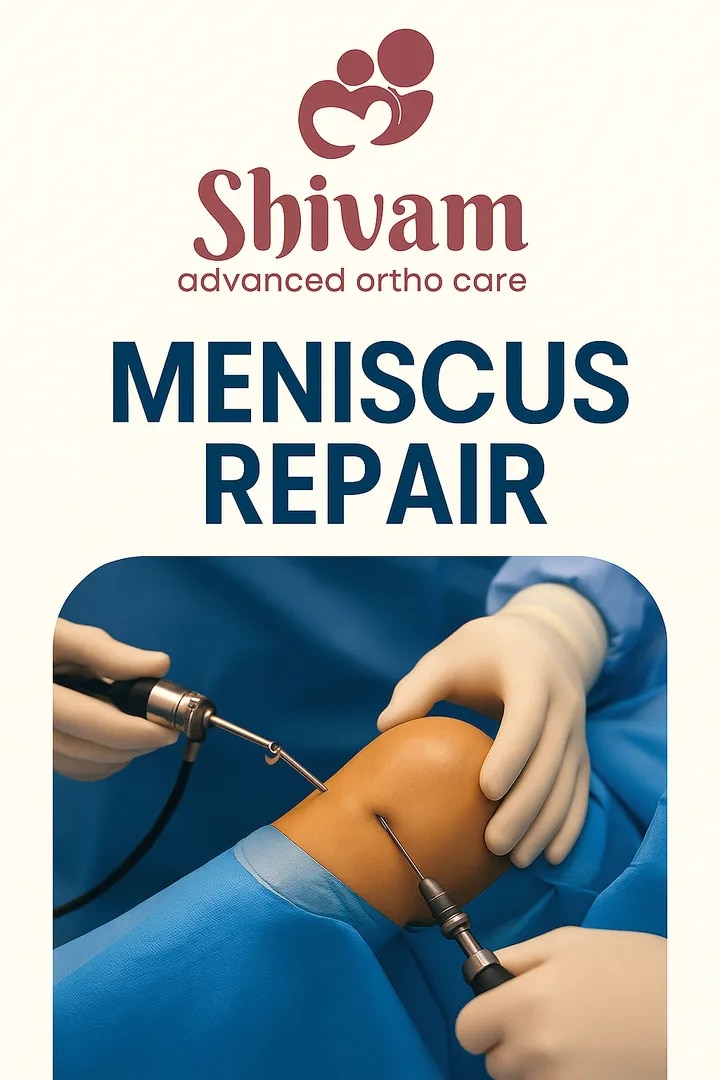
MENISCUS REPAIR SURGERY
Description
Meniscus Repair Surgery – Preserving Your Knee's Natural Cushion
A torn meniscus can stop you in your tracks – but modern arthroscopic techniques allow us to save, not just remove, your knee's shock-absorbing cartilage. At Shivam Advance Ortho Care in Basaveshwar Nagar, Bangalore, our orthopaedic surgeons specialize in arthroscopic (keyhole) meniscus repair – stitching the torn meniscus back so it can heal, preserving your joint's natural cushioning.
We tailor each treatment plan: some tears are best repaired; others may require a partial meniscectomy (removing only the damaged fragment). We'll give you an honest, evidence-based recommendation and guide you through recovery under one roof – with in-house imaging, surgery, and post-op physiotherapy.
Why Patients Choose Us for Meniscus Surgery:
Meniscus-Preserving Philosophy – We repair wherever possible because saving the meniscus lowers your risk of early knee arthritis.
Arthroscopic (Keyhole) Technique – Small incisions, minimal pain, faster discharge, and barely-visible scars.
Accurate Pre-Operative Diagnosis – Digital X-ray, MRI correlation, and detailed clinical examination before deciding on surgery.
Honest, Non-Surgical Options – If your tear can be managed with physiotherapy alone, we'll tell you.
Complete Recovery Pathway – Structured post-op physiotherapy at our clinic; home visits available across Bangalore.
Sports-Injury Expertise – We treat athletes and active adults who want to return to sport safely.
Our Meniscus Treatment Services
Meniscus Tear Assessment & Diagnosis Clinical tests (McMurray, Thessaly), digital X-ray, MRI review, and tear classification by location, pattern, and size. Best for patients with knee pain after a twist or injury.
Arthroscopic Meniscus Repair Keyhole surgery using arthroscopic sutures and anchors to stitch the torn meniscus back to the joint capsule. Best for peripheral, longitudinal (“bucket-handle”) tears in younger, active patients.
Partial Meniscectomy Removal of only the irreparable torn fragment while preserving healthy meniscus. Suitable for complex or degenerative tears where repair isn't feasible.
Combined ACL + Meniscus Surgery A single-stage arthroscopic procedure that reconstructs the ACL and repairs or trims the meniscus at the same time. For patients with both an ACL tear and meniscus injury.
Meniscal Root Tear Repair Specialized repair for root-detachment tears that, if left untreated, rapidly accelerate arthritis. Often seen in sports trauma.
Revision Meniscus Surgery Re-repair or revision meniscectomy for patients with persistent symptoms or a re-tear after a previous procedure.
Post-Operative Rehabilitation Structured physiotherapy including protected weight-bearing, range-of-motion exercises, strengthening, balance work, and sport-specific progression. For all post-surgical patients.
Non-Surgical Meniscus Management Physiotherapy, activity modification, strengthening, and pain-relief modalities for stable degenerative tears. Best for older patients or those with non-displaced tears.
Signs You Might Need Meniscus Repair
A “pop” felt at the time of injury, followed by swelling within 24 hours
Knee locking, catching, or giving way
Pain along the joint line (inner or outer knee) when twisting or squatting
Difficulty fully straightening or bending the knee
Persistent swelling after activity
Instability on stairs or uneven ground
Your Treatment Pathway – Step by Step
Step 1 – Consultation & Physical Examination Detailed history-taking, McMurray/Appley/Thessaly tests, and digital X-ray to assess joint alignment and rule out other causes of knee pain.
Step 2 – MRI & Tear Classification MRI review (we can arrange or use your existing scan) to determine tear type, location, and repairability.
Step 3 – Surgical Planning & Decision Transparent discussion: repair vs. partial meniscectomy based on your age, activity level, and tear characteristics.
Step 4 – Arthroscopic Procedure Typically 45–90 minutes under spinal or general anaesthesia; most patients go home the same day or stay one night.
Step 5 – Post-Operative Protocol Bracing and weight-bearing instructions tailored to the repair type (more protective after repair than after meniscectomy).
Step 6 – Physiotherapy & Milestone Tracking Progressive rehabilitation with assessments at 2, 6, and 12 weeks; functional tests before returning to sport.
Step 7 – Return to Activity Graded return to walking, gym, and sport with final clearance from your surgeon and physiotherapist.
Recovery Timeline After Meniscus Surgery
Protected Phase (0–2 weeks) Swelling control, brace use, gentle range-of-motion exercises, and non-weight-bearing or partial weight-bearing as advised.
Early Rehab (2–6 weeks) Regaining full extension and flexion, quadriceps activation, and weaning off crutches.
Strengthening Phase (6–12 weeks) Progressive loading, balance and proprioception drills, and light resistance training.
Return-to-Sport Phase (3–6 months) Sport-specific drills, agility work, and strength testing, with final clearance after functional assessment.
Note: Recovery after meniscus repair is slower than after partial meniscectomy because the stitched tissue needs time to heal. Your surgeon will provide a personalized timeline.
Frequently Asked Questions (FAQs)
Q1. What is the meniscus, and why is it important? A: The meniscus is a C-shaped cartilage pad in your knee that acts as a shock absorber and stabilizer. Preserving it reduces the long-term risk of knee arthritis.
Q2. How do I know if my meniscus tear needs surgery? A: Not all tears need surgery. Small, stable, or degenerative tears often become pain-free with physiotherapy. Surgery is usually advised for tears that cause locking, persistent pain, instability, or in active patients with repairable tears. We'll assess and advise honestly.
Q3. What's the difference between meniscus repair and meniscectomy? A: Repair stitches the torn meniscus back together so it can heal – preserving tissue but requiring slower, more protected recovery. Meniscectomy removes only the damaged portion – faster recovery, but less meniscus remains in the knee.
Q4. Is meniscus surgery painful? A: It's performed under anaesthesia, so you feel nothing during surgery. Post-op pain is manageable with medication and typically improves significantly within the first week.
Q5. How long is the surgery, and how long will I stay in hospital? A: Most arthroscopic meniscus procedures take 45–90 minutes. Many patients go home the same day; some stay one night depending on the repair complexity and your general health.
Q6. Will I need a brace or crutches after surgery? A: After a repair, yes – most patients use a brace and crutches with protected weight-bearing for 4–6 weeks. After a partial meniscectomy, you may walk with support within a few days and often don't need a brace.
Q7. When can I return to work? A: Desk work: often within 1–2 weeks after meniscectomy, and 2–4 weeks after repair. Physically demanding jobs take longer and depend on your surgeon's and physiotherapist's assessment.
Q8. When can I play sports again? A: Return to sport is typically 3–4 months after partial meniscectomy and 4–6 months after meniscus repair – only after strength and functional testing. Rushing this risks re-injury.
Q9. Can a meniscus tear heal without surgery? A: Some tears in the outer, well-blood-supplied zone of the meniscus can heal, especially in younger patients. Degenerative tears in older adults often settle with physiotherapy. Tears in the inner avascular zone rarely heal on their own.
Q10. Will I get arthritis after meniscus surgery? A: Preserving your meniscus – especially through repair – reduces the long-term risk of arthritis. Removing large amounts of meniscus increases it. This is exactly why we aim to repair wherever possible.
Q11. Is MRI necessary before surgery? A: Yes, MRI is usually essential to confirm the tear pattern, location, and whether it's repairable. We can arrange imaging or review an MRI you already have.
Q12. Is meniscus surgery covered by insurance? A: Arthroscopic meniscus surgery is commonly covered by health insurance when medically indicated. Our team will help with documentation, pre-authorization, and cashless/reimbursement claims.
Q13. Do you offer physiotherapy after surgery? A: Yes – post-operative rehabilitation is done in-house at our clinic, or as home physiotherapy in Bangalore if you can't travel. This continuity is a major reason our patients recover well.
Q14. What are the charges for meniscus repair surgery? A: Costs depend on the procedure type (repair vs. meniscectomy), implants used, and length of stay. Please call 08048035347 for an estimate after consultation.
